
Stop Waiting for Your Team to Get Good at AI
You bought the seats. You sent your team a prompting cheat sheet and a hopeful little email. A month later, nothing is faster.
You did not fail. You just believed the standard story about AI at work, and that story is wrong. It says the path is simple: buy the tools, train the people, push up adoption, and productivity follows.
It does not.
More training will not fix it. You need close to the opposite. Stop making "using AI" the goal and start making getting the work done better the goal.
The rollout that changes nothing
This pattern shows up on small teams and large ones alike.
Watch what happens whenever AI arrives on a team. A few people start poking at it right away. They try things nobody showed them, wire it into work they already do, and keep asking what else it can do. Others use it when there is a clear reason to, then set it down. And some tried it once, did not get much back, and never came back to it.
That last group is not being difficult. Most of them are not against AI at all. They simply do not have a reason to get good at it, and no workshop is going to manufacture one.
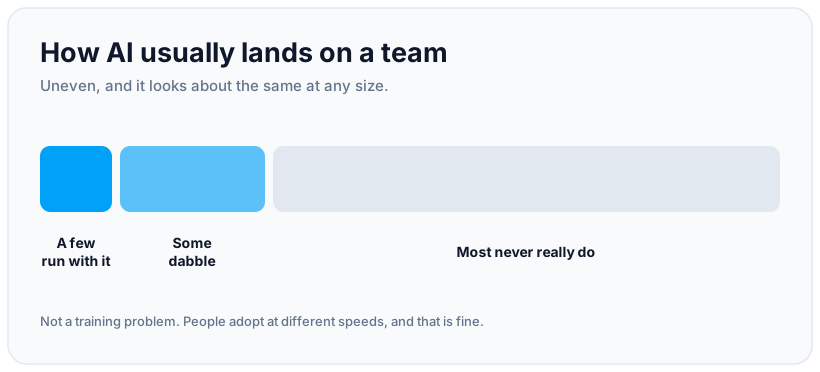
The same uneven pattern shows up on almost every team.
Dashboards call this "adoption." They count the seats bought, the logins, how many people opened the company's approved tool this month. Meanwhile the work moves at exactly the same speed it did before. That gap, between AI activity and the business actually improving, is the whole problem.
A person who uses ChatGPT to reword three emails a week is technically an AI user. So is a workflow that reads every new lead, updates the CRM, drafts the follow-up, creates the task, and puts it in front of a salesperson before breakfast. Those are not remotely the same thing. One is using AI. The other is changing how the business runs.
Using it and using it well are different skills
Anyone can type a question into ChatGPT. That part is trivial. Point it at a task, hit enter, and watch something happen. It might be right. It might be wrong. Worse, it might be almost right in a way that looks convincing enough to ship.
Using it well is a craft. You have to know when the answer is off. You have to recognize when a manual task should become a saved setup instead of a prompt you retype every Monday. You need to know which parts of a job require judgment and which are just repetitive steps for a machine, what information the system needs and what it should never touch, and you have to check the work before you trust it.
Give the same task to two people and the gap shows up in five minutes. One pastes in a vague line, takes the first output, and sends it. The other gives the model context, says exactly what they want, spots the mistake, fixes it, and gets something better in less time. Same tool. Same seat. Different outcome.
This is where most AI efforts get stuck. Half your team will never become that second person. They are perfectly smart. They just have a real job to do, and that job is not "get good at AI." Building that skill takes reps, curiosity, experimentation, and enough failures to learn where the tool helps and where it does not. You cannot will everyone across that gap, and trying will wear you out.
Training everyone to prompt is ten percent of the game
The standard advice is to train your team to prompt. Run a workshop, hand out the cheat sheet, show everyone how to write a better prompt. That covers about ten percent of what matters. The rest is knowing which work belongs to a machine in the first place, and that answer changes for every business. No cheat sheet contains it.
A real estate brokerage does not need everyone to become an expert prompt engineer. It needs listings turned into marketing content without someone spending an hour doing it by hand. A law firm does not need attorneys writing elaborate prompts. It needs documents organized, summarized, compared, and routed without junior staff doing the same mechanical work every day. A sales team does not need another workshop on "10 ChatGPT prompts for salespeople." It needs leads followed up with consistently, notes captured, records updated, and opportunities surfaced before they go cold.
Prompt training feels productive because it is easy to organize. You can put it on a calendar, send the recording around afterward, even measure attendance. But it changes almost nothing if nobody changes the underlying workflow. The people who were going to be good at this were probably already experimenting. Everyone else still has no idea which tasks are worth handing off.
If you want the version for one person deciding how far to take AI themselves, I wrote about that ladder here. This post is about the harder problem: the rest of the team that will never climb it.
Adoption is the wrong scoreboard
Asking whether your team is using AI hides everything you actually care about.
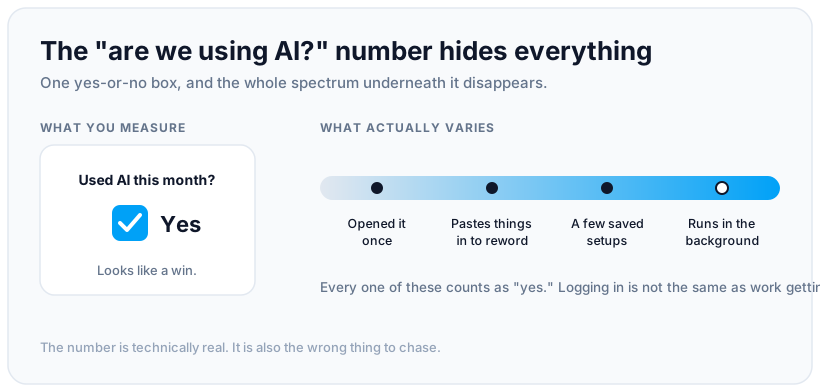
One checkbox, and the whole spectrum underneath it disappears.
That metric counts everything the same. Opening the app once counts. Pasting emails in to reword them counts. Brainstorming a meeting agenda counts. A workflow that runs every morning before anyone logs on counts. The number is real, and it is almost completely useless.
What you actually want to know is harder. What work is happening differently because of AI? How many hours disappeared? How many handoffs and repetitive steps disappeared? How much work that used to take three people now takes one? How much faster can a customer get an answer? How many follow-ups happen on their own that used to get forgotten? Those are business questions. "Seventy-eight percent of employees used AI this month" is not.
It is easy to spend real money getting AI into everyone's hands and still find that almost nothing about the actual work changed. That is the trap. Deployment looks impressive, and a dashboard full of adoption numbers looks impressive, but neither tells you whether anyone is getting more done. You can put an AI tool in front of a thousand people and change almost nothing, or quietly automate ten painful processes and change how the company runs. The second one looks far less impressive on a dashboard. It also makes you more money.
What actually works for a small team
Split your people into two groups and treat them differently.
Your curious ones, the tinkerers, are worth their weight. Give them room, and give them somewhere to put what works. When a power user builds a quote calculator or a listing writer that actually lands, it should not die in their head. Save it. Document it. Turn it into something the next person can open and use. One person's good setup becomes the team's default. That is the real shift: you stop asking everyone to learn the skill and start turning one person's skill into a company capability.
A salesperson figures out a better way to qualify leads. Capture it. An operations person builds an automated report. Capture it. Someone turns a new listing into five pieces of marketing content. Capture it. The goal is not to create more AI experts. It is to capture the work of the experts and make it reusable. One good workflow can be worth more than a hundred people sitting through an AI workshop.
Here is one that saved real hours. Building client-facing decks used to eat whole afternoons, and most of that time went into nudging the logo, header, footer, and tagline into the right place on every slide. One person turned that into a reusable setup in Claude. Now you describe the deck and it comes back assembled correctly every time. The knack for how the decks are supposed to look stopped living in one person's head and became something anyone could run in a minute.
The bigger lesson came next. It turned out half the company had the same problem, so the setup got packaged into something anyone could open and run without building it themselves. That is what makes adoption stick. Nobody is learning a tool. They open it, see the finished result right away, and keep using it because it just works.
Everyone else is the real question
This is where most companies make the wrong move. They see that people are not using AI and decide those people need more training. Maybe. But often they do not need training at all. They need the work to get easier.
Stop asking them to change how they work just so they can use AI. If the repetitive part can be handled for them, inside the tools they already use, let it happen there. Their job becomes checking the output instead of building it from scratch.
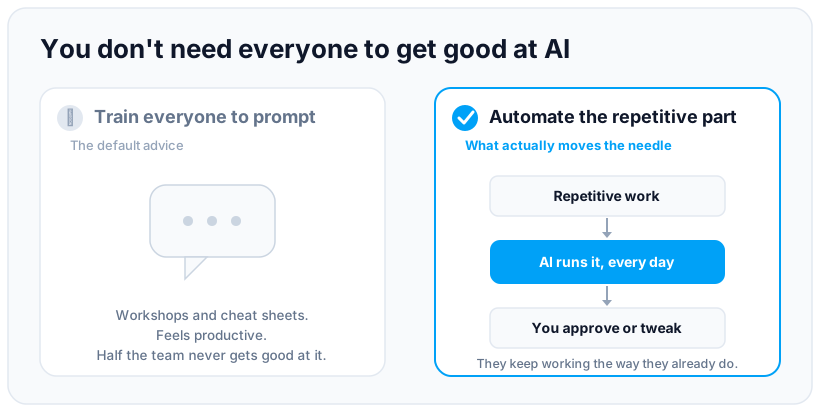
One of these you can actually pull off with a small team.
Think about the invoice follow-ups someone chases by hand. The inquiries retyped into the CRM one at a time. The weekly social posts, the appointment reminders, the meeting notes someone cleans up and sends around, the same three reports rebuilt every Monday, the spreadsheet nobody has gotten around to automating, the emails that are identical except for a name and a detail or two. None of that needs a human typing prompts. It needs to just happen, with a person glancing at it before it goes out.
That distinction matters. AI does not always have to be a new thing your employees have to do. Sometimes the best version of it is something they never notice. Your team is not shopping for a tool to help them do the work. They just want the work done.
Start with the boring stuff
The best AI opportunities are often embarrassingly boring, and that is a feature, not a bug. Companies love talking about AI strategy, agents, copilots, and whatever the newest word is. Meanwhile someone is spending six hours every Friday copying information from one spreadsheet into another. Start there.
Look for work that is:
- repetitive
- rules-based
- frequent
- time-consuming
- easy to check
- annoying enough that everyone has learned to tolerate it
That is usually where the money is hiding. Do not start with the most impressive AI project. Start with the task everyone hates. If it takes twenty minutes a day, that is more than eighty hours a year for one person. If five people do it, you have found more than four hundred hours.
Now ask a different question. What would happen if nobody had to do that by hand anymore? That is a far better conversation than "how do we get more people using ChatGPT?"
The human still matters
One important caveat. Handing the repetitive part to the AI does not mean taking humans out of the loop. Some work should never be fully automated. Anything involving judgment, sensitive information, customer relationships, money, legal decisions, or reputational risk deserves real human oversight.
The point is not to remove people. It is to stop spending human attention on work that does not need it. A person reviewing a thirty-second AI-drafted report is not the same as a person spending two hours building it from scratch. A salesperson checking an automatically prepared lead summary is not the same as one copying information between systems by hand. An agent approving a drafted listing description is not the same as one starting from a blank page every time. The human is not being replaced. The human is being moved to the part of the process where being human actually adds value.
Measure the right thing
Stop asking whether your team is using AI. It is the wrong question, and it makes you spend money and feel busy while nothing actually moves.
Ask this instead. How much of our repetitive work is still done by hand, how much is half-automated, and how much just runs itself? That is the scoreboard that matters. You can even track it at the process level. Take your twenty most repetitive workflows and give each one a simple status:
Manual → Assisted → Automated → Monitored
Then move them to the right. You do not need to automate everything, and you do not even want to. But if six months from now the same twenty processes are still manual, your AI strategy has not really changed the business. When that mix shifts, the business gets faster. When adoption goes up, you just bought logins.
The one line to remember
Turning your team into AI power users is a losing game. Most of them will never get there, and they do not need to. Chasing it burns your time and your money.
You win by taking the work off their plate. Pick your most repetitive weekly task. Hand the repetitive part to the AI, so it runs on its own and a person just checks it before it goes out. Then measure whether the work got done, not whether anyone used AI. Then do it again.
Eventually you stop having an "AI initiative." You just have a business that runs better. That is the goal. Not more logins, not more prompts, not another workshop. Less work by hand, more work getting done.
Do that, and you are already ahead of the enterprise down the road that signed an eight-figure check to count logins.
Minh Le leads AI at MinhMax Studio, where the job is usually taking repetitive work off a small team's plate, not turning that team into prompt engineers. If your AI rollout is all logins and no lift, reach out. No deck, no pressure.